
Your needs, this model
Does it fit your priorities?
Does the 12G SDI M.2 support 4K60 capture?
The model-specific page lists a 4096x2160 60fps input ceiling, and its technical table includes 4096x2160p60 and 3840x2160p60 capture rows. Magewell qualifies actual rate by PCIe bandwidth and internal working frequency, so check the source timing and host lane allocation rather than treating the row as a system-wide guarantee.
Explore this need in the finder →Does its 12G-SDI name mean four independent 3G-SDI channels?
No. Magewell describes one capture channel fed by single-link 12G SDI or a quad-link 3G SDI signal. The multi-link connectors carry one assembled video source; they are not four separately captured sources as on a Quad SDI card.
Explore this need in the finder →Which 12G M.2 SKU should I inspect?
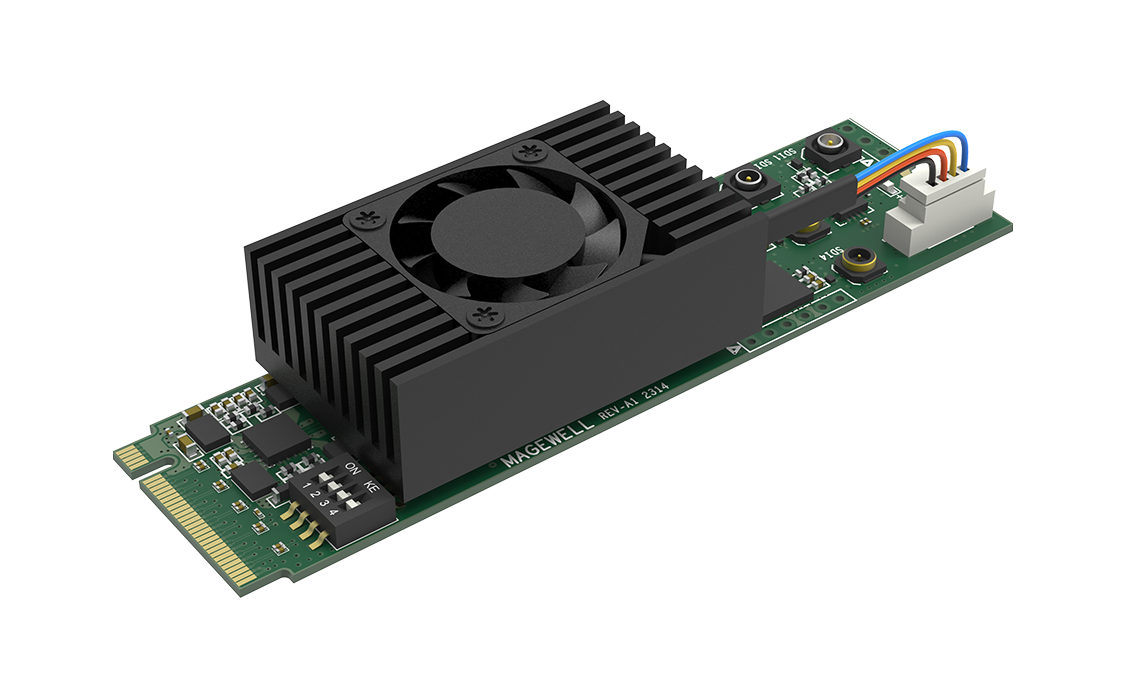
The U.S. listings distinguish 115610000 with a fan/heatsink from 115610001 without it, and Magewell's product images show each separate board. Match that suffix to case height, cooling plan and actual box contents; the pictured fan-equipped version is not a silent stand-in for the bare card.
Explore this need in the finder →Single-channel 12G SDI capture · 4K60 modes · M.2 PCIe Gen3 x4
The Eco Capture 12G SDI 4K Plus M.2 is an internal SDI module for a host with an M.2 2280 Type M PCIe Gen3 x4 path. Magewell identifies two packages: SKU/MFR 115610000, pictured with a fan/heatsink assembly, and 115610001 without that assembly. A U.S. listing for each part helps distinguish the package. Their cooling form differs, but the capture card remains a single channel; the heat-sink option does not turn it into a multi-channel board or change its SDI signal path.
One 4K SDI source, with multiple link choices
The manufacturer describes a single input channel that can accept single-link 12G SDI or a 12G feed assembled from dual-link 6G or quad-link 3G SDI. Its product page states support up to 4096×2160 at 60 fps. The technical sheet separately lists capture rows through 4096×2160p60 and 3840×2160p60, plus 1920×1080p120. Unlike a card with four independent SDI inputs, the multiple SDI links here can carry one source raster into a single channel. Count the actual signal path and connectors in your production chain before assuming the 3G links are four separate cameras.
The high-rate table is not a promise of an identical sustained result on any motherboard. Magewell says actual rate may be constrained by PCIe bandwidth and internal working frequency. The relevant check is whether the target computer routes the M.2 slot with the required Gen3 x4 lane capacity while also meeting thermal and clearance needs. If a source uses a particular level, frame rate, embedded audio or multi-link arrangement, validate that exact standard rather than relying on the model name alone.
Cooling and package selection change installation
The 115610000 package includes the fan/heatsink configuration shown in the official image; 115610001 is the no-heatsink board. The manufacturer’s images make the physical distinction visible, and the U.S. retailer listings identify the two package labels. The no-heatsink image is not a claim that an arbitrary enclosure can cool the board adequately. The fan-equipped unit also needs physical clearance and an airflow path; no temperature, fan noise or long-duration capture measurement is claimed in this assessment. Ask the seller to confirm the part suffix, cables and included pieces, because part-level cooling affects the system design.
The product page lists SDI cable and BNC connector accessories, but the exact package should be compared against the signal-link topology you need. A 12G SDI cable path differs from four separate 3G feeds; each connector and cable must correspond to the intended standard. This is a small M.2 module and not a full-size PCIe card, USB capture device or mSATA storage drive. Magewell’s Eco FAQ explains the PCIe M-key distinction and warns that the chassis must dissipate heat.
Software, HDR and passthrough are separate checks
Magewell lists Windows and Linux driver support, OBS among the compatible software, and the model technical page lists V4L2/ALSA and Windows capture interfaces. The product page shows driver updates, but an update history is not a guarantee for a specific distribution, kernel, host BIOS or OBS setup. Magewell’s family FAQ says no Mac driver is supplied. Verify the current operating-system support and exact capture profile against the machine that will run it.
The reviewed material supports SDI capture modes; it does not establish HDR file capture, display passthrough or an SDI output. A device that receives a 4K60 signal is not necessarily preserving HDR in the recorded file, and a capture-only input cannot be treated as a monitor output. If you need a monitor feed, include a separate router or choose hardware with an explicit output path. Compared with the Quad SDI M.2, this unit targets a single high-bandwidth signal rather than four independent conventional SDI channels. Compared with the Dual SDI M.2, it raises the documented SDI class and host generation while reducing input count.
Purchase decision
Shortlist it when one SDI source needs a documented 4K60 or 1080p120 capture mode and the internal host can supply M.2 PCIe Gen3 x4. Then resolve the exact 115610000 versus 115610001 cooling package, case clearance and airflow; check the source’s single/dual/quad-link cabling, raster, frame timing and audio; and verify the application and driver. The evidence establishes the manufacturer’s mode table and physical variants, not hands-on stability or measured throughput in an arbitrary build.
Manufacturer sources
- Magewell product page: SDI input, SKU variants and package details
- Magewell technical specifications: capture rows, OS and host requirements
- Magewell Eco Capture FAQ: M.2 interface, drivers and chassis cooling
- U.S. identity listing for fan/heatsink SKU 115610000
- U.S. identity listing for no-heatsink SKU 115610001
Key specifications
Key details at a glance
| Signal input | One single-link SD/HD/3G/6G/12G SDI input, or a 12G feed assembled from dual-link 6G SDI or quad-link 3G SDI; one capture channel, not four independent 3G inputs. |
|---|---|
| Confirmed capture formats | Manufacturer technical rows list 4096x2160p60 and 3840x2160p60, and 1920x1080p120. Actual capture rate can be constrained by PCIe bandwidth and internal working frequency. |
| Confirmed passthrough formats | |
| Computer connection | Pcie |
| Named compatible software | OBS Studio / VLC / VirtualDub / XSplit / vMix / Wirecast / Magewell Capture SDK |
| HDR recording | The reviewed mode table does not establish hdr recording modes or an output-file workflow. |
Use the exact model’s instructions for operating limits, supplied equipment and version differences.
Sources for this review
Sources for this assessment
- Magewell Eco Capture 12G SDI 4K Plus M.2 product page, inputs and SKU options
- Magewell Eco Capture 12G SDI 4K Plus M.2 technical specifications and mode table
- B&H U.S. identity listing for fan/heatsink SKU 115610000
- B&H U.S. identity listing for no-heatsink SKU 115610001
- Magewell Short FAQs about Eco Capture
- Official Magewell image, fan/heatsink SKU 115610000
- Official Magewell image, no-heatsink SKU 115610001


Check your complete signal path
Choose the source format, desired captured signal, passthrough target, computer connection and software together. A single device must support that whole arrangement.