
Your needs, this model
Does it fit your priorities?
Does the 3G version support 1080p60 capture?
Yes. AJA’s dedicated Corvid 3G mode table lists 1080p50, 59.94 and 60 over SDI. This is not a 4K feature and is distinct from Corvid 1’s 1080p30 ceiling.
Explore this need in the finder →Does Corvid 3G have HDMI or 4K input?
No. Its listed input is 3G-SDI, and the exact format table covers SD, HD and 2K but not 4K. An HDMI source needs an external compatible conversion path.
Explore this need in the finder →How is it different from Corvid 1?
The 3G model adds higher-rate 1080p and 2K modes plus a mixer/keyer and RGB buffer color-conversion features. It remains one input/one output, not a dual-channel card.
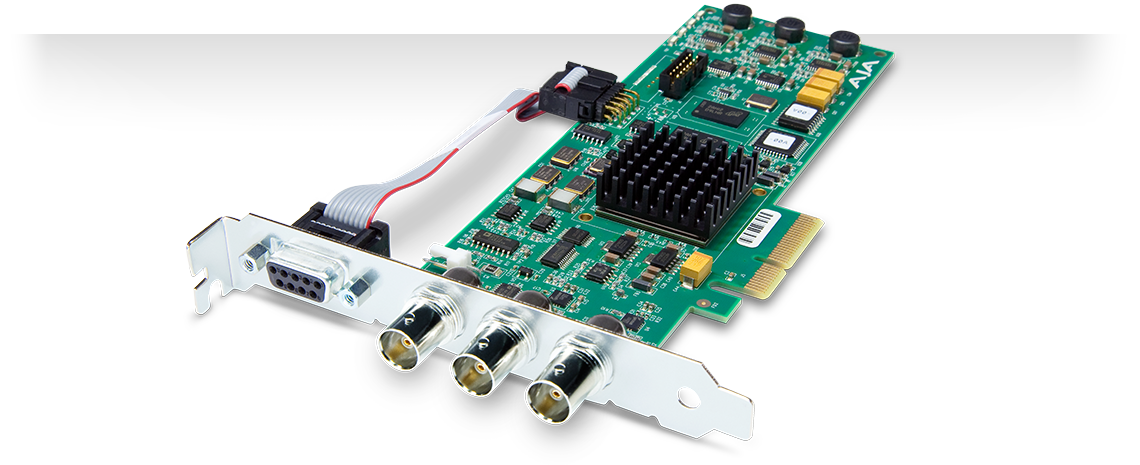
Explore this need in the finder →AJA’s Corvid 3G is an earlier OEM PCIe video I/O board for SDI systems. It is related to the original Corvid/Corvid 1 but is a distinct model: AJA documents a video-processing mixer/keyer module and 2K/3G capability for the 3G board, while Corvid 1 stops at 1080p30 and lacks that 3G-only processing feature. Both are discontinued and AJA identifies KONA 1 as their successor. This assessment is best used for an existing broadcast or post-production system, not as a claim that the board is a current consumer capture solution.
What the 3G label changes
The model-specific AJA sheet lists 3G-SDI input and output, including SD, HD and 2K timings. Its HD table includes 1080p50/59.94/60; its 2K list ends at 25p. The NTV2 device reference identifies one SDI input, one SDI output, reference, LTC and RS-422. That is a one-source input path with a separate output connection, not a four-channel card. AJA also documents one audio system with up to eight channels. The 3G board has additional frame-buffer support for 2K, VANC and 16-bit RGB, and a hardware color-space converter for YCbCr SDI to/from RGB buffer use. These are developer I/O details, not a blanket picture-quality guarantee.
There is no HDMI socket, so an HDMI-only camera or game console needs a compatible SDI conversion stage. Do not assume the SDI output is a direct pass-through: the technical pages describe input and output I/O, but do not provide a consumer display-path matrix. No 4K capture, HDMI HDR, VRR or rate-specific OBS mode is established. If a 1080p60 SDI capture path is the requirement, the published mode table supports that timing; an exact workstation, driver, application and signal format still need their own checks.
Legacy host compatibility
The board uses four-lane Gen 1 PCIe. AJA’s current SDK device page retains a legacy entry and records Mac OS SDK support from an early release, with the hardware feature set feature-complete in SDK 15.0. That provides a specific historic reference, not broad compatibility with every later operating system. The exact supported driver, motherboard, application API and firmware must be confirmed for an installed system before a replacement board is sourced. This site does not claim personal testing, ownership or independent latency measurements.
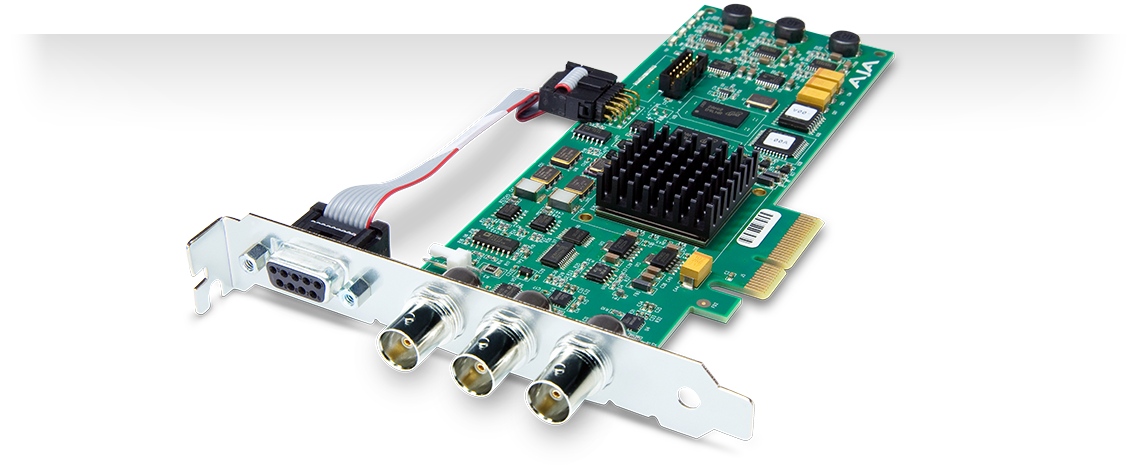
The AJA product page marks Corvid 3G discontinued, and the NTV2 documentation says Corvid and Corvid 3G reached end of life in 2018. Its card image also looks very similar to Corvid 3G Fiber; the Fiber model is a separate signal-transport edition with fiber connectors and must not be substituted. Inspect the actual connector bracket and model code, not just a seller’s “Corvid” title. A used package may be missing control or reference cabling, and the documents do not establish any particular listing’s condition.
Who should compare it
Compared with Corvid 1, the 3G version adds higher-rate HD, 2K, mixer/keyer processing and RGB buffer/color conversion support, while retaining a single SDI input/output pair. Compared with the Corvid 22, it has fewer documented independent SDI channels but a different feature set and connector plan. The latter has two fixed SDI inputs and two outputs; it is not an equivalent one-for-one substitution. These legacy boards suit integrators matching an exact older workflow; they are poor choices for simple USB streaming, current HDMI consoles or users who need a current OS/application guarantee.
Before considering an offer, verify that it is the non-fiber Corvid 3G, check the SDI timing and any 2K workflow, confirm a usable PCIe slot and supported AJA SDK/OS, and budget for required converters and cables. The product identity and format ceiling can be documented; current retailer availability and a working second-hand installation cannot be inferred from the manufacturer page.
Key specifications
Key details at a glance
| Signal input | 1 x 3G-SDI input; 1 x 3G-SDI output; reference, LTC input and RS-422 |
|---|---|
| Confirmed capture formats | SD 525i59.94, 625i50; HD 720p50/59.94/60, 1080i50/59.94/60, 1080p23.98 through 60 and listed PsF modes; 2K 2048x1080p/PsF through 25 |
| Confirmed passthrough formats | |
| Computer connection | 4-lane gen 1 pcie. |
| Named compatible software | AJA NTV2 SDK/developer integration |
| HDR recording | No rate-specific hdr recording mode is documented; do not infer hdr from input, an hdbaset loop or hevc capability. |
Use the exact model’s instructions for operating limits, supplied equipment and version differences.
Sources for this review
Sources for this assessment
Check your complete signal path
Choose the source format, desired captured signal, passthrough target, computer connection and software together. A single device must support that whole arrangement.