
Your needs, this model
Does it fit your priorities?
What video and audio connections does the Hexa CVBS card actually accept?
The one DB25 connector carries six CVBS composite video inputs and six analog stereo L+R audio pairs through the listed DB25-to-six-A/V cable. It is not six SDI or HDMI inputs, so verify that each source supplies composite video.
Explore this need in the finder →Can Pro Capture Hexa CVBS record composite video at 1080p60?
No 1080p60 mode is supported in the reviewed model evidence. Magewell specifies standard-definition capture up to 720x576 pixels and up to 30fps, with NTSC, PAL and SECAM support; scaling does not add source detail.
Explore this need in the finder →What must fit in the computer before choosing this six-channel card?
Confirm a usable PCIe Gen2 x1 slot, low-profile bracket opening, clearance for a 118.16x68.88mm board and space for the attached DB25 breakout. The manufacturer lists the breakout cable and bracket, but the actual U.S. seller package should still be checked.
Explore this need in the finder →This is a source-based assessment of Magewell’s Pro Capture Hexa CVBS, part 11250 (manufacturer SKU 112500000), not a hands-on digitizing test. It is a six-channel standard-definition composite capture card for a very different job from the HDMI and SDI cards elsewhere in this library: bringing several legacy analog sources into one PCIe computer. The central buying question is whether your source really is composite CVBS and whether the modest SD resolution is appropriate for the material you need to preserve.
Six composite paths, carried through one DB25 connector
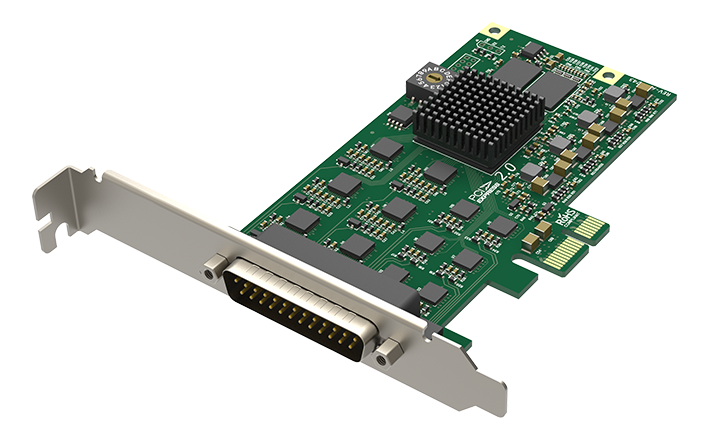
Magewell identifies six CVBS video inputs and six analog stereo audio pairs (left and right). The card presents them through one DB25 connector rather than six BNC jacks on its bracket. The manufacturer’s package list includes a DB25-to-six-A/V breakout cable, which fans that connector out into the six source paths. This is a materially different hookup from a normal six-BNC SDI card: check the supplied cable, label each branch and confirm how the source’s video and audio connectors map before designing a rack or cable harness.
CVBS means composite video. Do not confuse it with S-Video, component video, HDMI or SDI just because a source device can offer several of those outputs. A VCR, legacy camera or compatible analog security feed may provide composite, but a component-only or S-Video-only source needs a different capture route or an appropriate conversion stage. The six-channel count is useful when several separate analog feeds need to reach a single system; it is not evidence that the card accepts six modern digital signals or converts them into HDMI.
Standard definition is the hard boundary
The technical specification sets the input and capture-image ceiling at 720×576 pixels and the listed capture-frame-rate ceiling at 30 fps. It supports NTSC, PAL and SECAM and can automatically detect the composite video standard. That is a practical range for many legacy sources, but it is not a 1080p or 4K digitizer. The card includes cropping, scaling, de-interlacing, aspect-ratio and color-format conversion, yet scaling an SD source to a larger canvas does not restore detail that was never present in the composite signal.
The existing finder’s capture-rate choices start at 1080p60, so none represents the Hexa CVBS’s actual 720×576-at-up-to-30-fps mode. An analog-only finder result can still surface it for the correct source category; adding an HD capture requirement should correctly remove it. That makes the model a specialist candidate for legacy-video or multi-camera SD workflows rather than a substitute for a game-capture card. If a production needs a particular NTSC or PAL field treatment, exact de-interlacing, audio synchronization or preservation codec, check that full chain in the target software rather than relying on the card’s broad format list.
Check the PC and physical package
The Hexa CVBS is an internal PCIe Gen2 x1 board with a low-profile bracket. The technical sheet gives a board size of 118.16×68.88 mm without its bracket and maximum power consumption of about 6.12 W. A low-profile bracket helps with compatible small-form-factor systems, but it does not remove the need for an actual PCIe slot, the proper bracket opening and a clear path for the DB25 cable. Verify that the case can close with the breakout attached and that the cable can bend without pressing against neighboring cards.
The product page lists one Hexa CVBS card, one DB25-to-six-A/V cable and one low-profile bracket. It does not list source cameras, composite leads, storage or a separate monitor/output device. The U.S. authorized-dealer listing bridges the product name and part number; the manufacturer page supplies the SKU and package information. Match the part and cable package on the offer rather than assuming that every seller bundle includes the same extras.
Software supports multiple workflows, not one automatic outcome
Magewell lists Windows, Linux and Mac support and names OBS among compatible applications. Its detailed specification describes DirectShow and DirectKS on Windows, V4L2 and ALSA on Linux, and a broad set of other DirectShow/V4L2 streaming or encoding programs. Capture Express and the Magewell SDK are also part of the wider product software story. A conservative Windows/OBS plan is documented here, with a separate general Mac software/host arrangement and no unsupported HD mode. Before a multi-source installation, confirm how each app enumerates the six video inputs and their associated audio pairs, what format each source is producing, and how the chosen operating-system driver exposes the card.
The technical sheet describes independent stream settings for a selected input, multiple cards per system and two video-processing pipelines. Those statements are not a workload benchmark for six fully processed channels on a particular PC. The six-channel identity and connectors make this a credible multi-feed design, but host bandwidth, application behavior, capture configuration and storage are still system-level checks. The product’s SDI/HDMI-free signal path also means it has no documented HDMI passthrough or display output; a monitor must be served by the computer or a separate device.
How it differs from other analog-capable cards
Pro Capture AIO and the DVI-family devices in this library accept different selectable signals or breakout configurations, usually as one capture path per selected input. Hexa CVBS instead devotes its DB25 breakout to six composite video feeds and six analog audio pairs, while retaining a standard-definition ceiling. Choose it when channel count and legacy composite connections matter more than HD resolution; for one VGA, component, DVI or HDMI source, another model may have a closer connector and mode fit. The broader output/streaming range of unrelated models does not erase this card’s specific advantage or its SD limit.
Before choosing it
Confirm that all intended video sources provide composite CVBS in NTSC, PAL or SECAM, and identify the audio and video branch for each one. Check whether 720×576 at up to 30 fps meets the preservation or monitoring goal, whether the computer has a usable PCIe Gen2 x1 connection, and whether the low-profile bracket and DB25 breakout physically fit. Verify the operating-system driver and the app’s device routing before relying on six-channel concurrency. This model is not a match for HDMI, SDI, 1080p60 capture or HDMI passthrough. The published limitations and capabilities are drawn from model-specific manufacturer pages and a U.S. identity bridge; no product was personally installed, used or benchmarked, and no price, current stock or seller experience is claimed.
Sources: Magewell Pro Capture Hexa CVBS product page, model technical specifications, the technical-specification PDF, and the checked U.S. dealer identity listing.
Key specifications
Key details at a glance
| Signal input | 1x DB25 breakout carrying 6x CVBS composite video inputs and 6x analog stereo audio pairs (L+R) |
|---|---|
| Confirmed capture formats | CVBS composite input up to 720x576 and up to 30fps, with NTSC/PAL/SECAM standards; not an HD capture mode. |
| Confirmed passthrough formats | |
| Computer connection | Pcie gen2 x1 |
| Named compatible software | OBS Studio / VLC / VirtualDub / XSplit / vMix / VidBlaster / Wirecast / Magewell Capture Express / Magewell Capture SDK |
| HDR recording | Not documented |
| VRR passthrough | No |
| Analog audio input | Six analog stereo audio input pairs (left and right), carried on the same db25-to-six-a/v breakout as the six composite video feeds. |
| Cables listed in the box | DB25-to-six-A/V breakout cable ACC00040, listed in the manufacturer package |
Use the exact model’s instructions for operating limits, supplied equipment and version differences.
Sources for this review
Sources for this assessment
- Magewell Pro Capture Hexa CVBS model page, exact part/SKU, interfaces and package
- Magewell Pro Capture Hexa CVBS model-specific technical specification and software matrix
- Magewell Pro Capture Hexa CVBS technical specifications PDF, revision 2025-12-10
- Coremicro U.S. dealer identity bridge for Pro Capture Hexa CVBS
- Magewell Pro Capture bounded family list, including Hexa CVBS part 11250
- Exact Magewell Pro Capture Hexa CVBS product-page image
Check your complete signal path
Choose the source format, desired captured signal, passthrough target, computer connection and software together. A single device must support that whole arrangement.