
Your needs, this model
Does it fit your priorities?
Can the original UltraStudio Express accept HDMI?
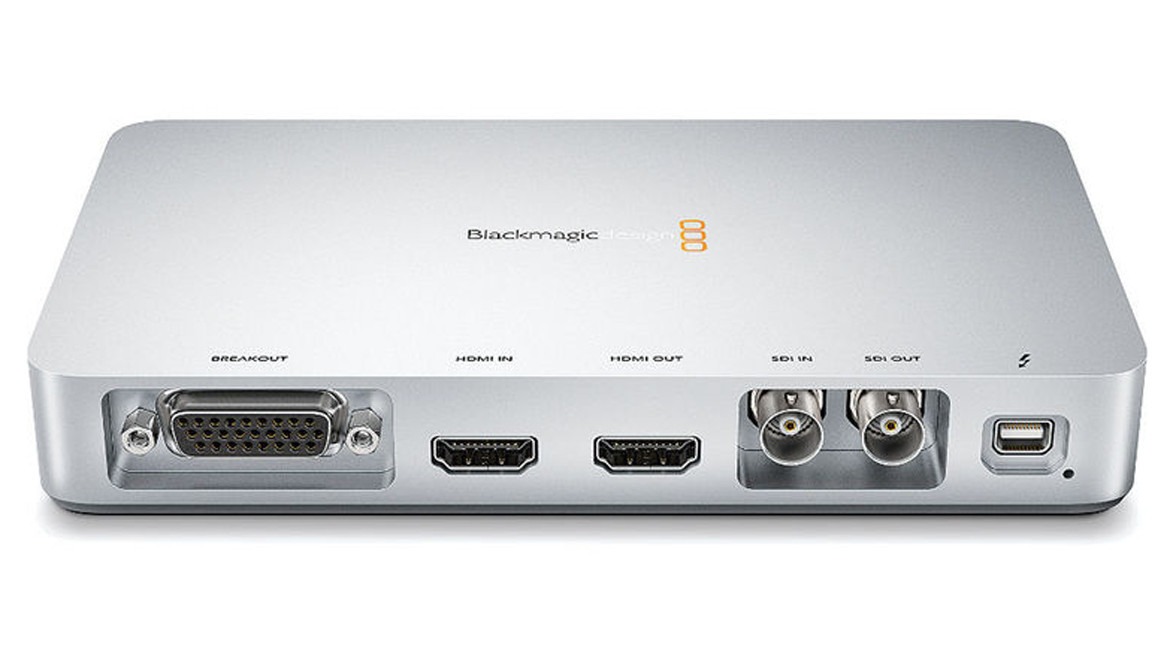
Yes. The 2012 announcement lists built-in 3 Gb/s SDI and HDMI inputs and outputs. Do not apply this input direction to later similarly named models such as Express HD, whose HDMI connector is a monitor output.
Explore this need in the finder →What does the 1080p60 claim cover?
The press release describes common SD/HD capture and playback up to 1080p60, but it does not give an exhaustive connector-specific mode matrix. Check the exact source, input, cable and application; no separate analog 1080p60 guarantee is assigned here.
Explore this need in the finder →What should I verify before using analog sources?
The original press release says two interchangeable breakouts were supplied: a consumer RCA cable and a professional BNC/XLR cable with reference and RS-422 control. Verify that the correct cable is actually present and that its connector layout matches the source; no bundle contents are inferred from the unit image.
Explore this need in the finder →The original UltraStudio Express is a compact external SD/HD capture-and-playback unit from Blackmagic Design’s 2012 Thunderbolt generation. It is not the later UltraStudio Express HD or the much newer Express Recorder 3G. The original announcement describes a portable, bus-powered device with 3G-SDI, HDMI and analog connectivity, intended to connect a computer to cameras, decks and monitoring equipment. This is a source-based assessment of the historical model, not a hands-on test or a current buying recommendation. Current U.S. packaging, seller availability and present-day driver support have not been established.
Separate the source input from the monitoring output
The original product release describes both 3G-SDI and HDMI inputs and outputs, plus analog connections through a breakout connector. Its stated range is common SD and HD formats up to 1080p60; it is not documented here as a 4K capture interface. The presence of both an input and an output connector is useful for studio routing, but the announcement does not establish every simultaneous capture-and-display combination. If a workflow depends on a particular HDMI monitor path while recording a source, check the exact software and signal-routing instructions rather than inferring direct passthrough from the port labels.
For SDI or HDMI capture, first confirm the source’s output timing and the receiving application’s selected format. “Up to 1080p60” is a ceiling for the documented SD/HD range, not a guarantee that every connector, cable, source and application operates at that setting. This distinction is especially important when dealing with older cameras and broadcast decks, where the connector may be familiar but the signal standard, frame rate or embedded audio behavior can differ.
The breakout cables are central to analog use
Unlike a small capture stick with all connectors on one shell, UltraStudio Express was supplied with two interchangeable breakout cables. The professional cable brings out analog component, S-Video and composite connections alongside XLR audio, AES/EBU, reference and RS-422 deck control. The consumer cable uses RCA-style connections for consumer equipment. That flexibility is useful for an archive or a mixed consumer/broadcast setup, but only when the correct cable is present and wired to the source you actually own. Do not assume that a used unit includes both cables just because the original release describes them in the package.
Analog component, S-Video and composite are different signal paths, not interchangeable labels for one input. Check the source connector, the compatible breakout, the video standard and any required audio leads before expecting an ingest to work. The accessible product material does not provide a separate complete analog timing matrix, so this assessment does not assign an analog 1080p60 capability or claim that every breakout combination supports the same formats.
Thunderbolt is not simply USB-C
The enclosure draws power through its Thunderbolt connection, which made the original unit portable without a separate power supply. For an existing setup, verify that the computer has a genuine Thunderbolt connection and that the cable and adapter chain are appropriate. A USB-C-shaped connector alone is not evidence of a supported host link. The 2012 launch material names Mac OS X and then-current editing applications, including Final Cut Pro X, Adobe Premiere Pro CS6 and Avid Media Composer 6; it is not a current OS or driver compatibility list. It also names Blackmagic Media Express. This review does not claim current OBS support, current Windows support, or successful operation with a new laptop.
Where it belongs beside newer models
The original Express is an earlier SD/HD device. UltraStudio Express HD is a separate, newer 3G-SDI/USB4-or-Thunderbolt 4 product with its own analog and monitoring arrangement; Express Recorder 3G is another distinct capture-only model. Do not apply their host requirements, connector directions or current support notes to the 2012 original. If you need a current 4K workflow, a USB-C computer without Thunderbolt, or a verified current streaming-app path, look for a model whose exact U.S. technical sheet covers those needs.
Practical checks for an existing unit
Confirm the exact name on the enclosure and compare the HDMI, SDI and breakout ports with the original UltraStudio Express rather than a similarly named successor. For an existing ingest station, check the source standard, input direction, application, OS, driver, Thunderbolt host and cable. For an offer, check whether the professional and consumer breakouts are actually included, whether their connectors match your source, and whether the seller can identify the unit’s working condition and return terms. None of those offer details are inferred from the product photograph or from the 2012 announcement.
Because no current U.S. package or present-day compatibility path was confirmed, this assessment keeps UltraStudio Express as a historical model reference rather than a recommendation to buy. Its original combination of SD/HD digital I/O and breakout-based analog connections is distinctive; its age, host interface and accessory dependence are equally important parts of the decision.
Source references: Blackmagic Design’s official release archive records the UltraStudio Express announcement on April 16, 2012. The technical release text is preserved by TV Technology as a republication of the Blackmagic announcement, not independent product testing. The exact-model image comes from the AbelCine UltraStudio Express listing; its retailer description and image are not manufacturer specifications or proof of a particular used package.
Key specifications
Key details at a glance
| Signal input | sdi / hdmi / analog_video |
|---|---|
| Confirmed capture formats | The 2012 release describes common SD/HD formats through 1080p60 and a 10-bit SD/HD capture/playback device. Built-in 3G-SDI and HDMI are inputs and outputs; the release does not provide a complete connector-by-connector matrix. / Analog video is available through interchangeable breakouts, but the reviewed release text does not give a separate analog timing table; no analog 1080p60 floor is assigned. |
| Confirmed passthrough formats | |
| Computer connection | Thunderbolt |
| Named compatible software | Final Cut Pro X / Adobe Premiere Pro CS6 / Avid Media Composer 6 / Adobe After Effects CS6 / Adobe Photoshop CS6 / Blackmagic Media Express |
| HDR recording | No hdr capture capability is established by the reviewed historical release. |
Use the exact model’s instructions for operating limits, supplied equipment and version differences.
Sources for this review
Sources for this assessment
- Blackmagic Design current UltraStudio technical selector and product listing
- Blackmagic Design official older release archive, April 16, 2012 entry
- TV Technology republication of Blackmagic Design's UltraStudio Express announcement
- AbelCine exact-model UltraStudio Express retailer listing
- AbelCine exact-model UltraStudio Express product photograph

Check your complete signal path
Choose the source format, desired captured signal, passthrough target, computer connection and software together. A single device must support that whole arrangement.