
Your needs, this model
Does it fit your priorities?
Does every UltraStudio 4K capture 4K at 60 fps?
No. The 2012 original is documented for SDI through 1080p60, with no complete 4K timing matrix. The 2013 Thunderbolt 2 replacement is documented for UHD 4K YUV through 60 fps over 6G-SDI; that is not a 4K DCI or 4K HDMI 60 fps guarantee.
Explore this need in the finder →What Thunderbolt generation should I check?
The 2012 launch names Thunderbolt but no generation; Blackmagic calls the October 2013 model a Thunderbolt 2 replacement. Inspect the exact rear panel and documentation rather than relying on USB-C shape or a guessed adapter chain.
Explore this need in the finder →Does an HDMI output establish consumer passthrough?
No. The historical release describes capture and playback connections, but the reviewed sources do not establish a simple HDMI source-to-display loop or every simultaneous routing combination.
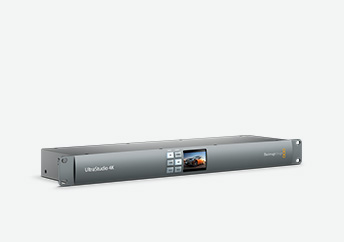
Explore this need in the finder →UltraStudio 4K is a rack-width external video I/O product whose un-suffixed name covers two documented generations. Blackmagic introduced the first model in 2012, then announced a Thunderbolt 2 replacement in 2013. Both are capture/playback units with broad professional and analog connections, but the generations should not be treated as one interchangeable signal path. This is a historical model assessment, not a hands-on test or a recommendation to buy a used unit. The available manufacturer information does not establish a current U.S. package, seller availability or present-day host and driver support.
Its 4K name needs a signal-path check
The September 2012 launch release describes full-resolution 4K alongside SD, HD and 2K, with dual-link 3 Gb/s SDI, HDMI and component analog connections; it identifies SDI support up to 1080p60 but gives no complete 4K connector-by-connector timing table. In October 2013, Blackmagic explicitly called out a new UltraStudio 4K model that replaced the previous one: the replacement added Thunderbolt 2 and 6G-SDI, and its release described UHD 4K YUV capture/playback up to 60 fps and RGB up to 30 fps through 6G-SDI. That is the useful documented 4K60 path for the later revision, not a safe claim for every early unit or every connection. The release does not establish a 4K DCI 60 fps ceiling or a connector-specific maximum for 4K HDMI. Before planning around a frame rate, check the exact generation, source timing, input, link arrangement, color format and software mode.
The model has both input and output connections for SDI, HDMI and analog video, making it a capture/playback bridge rather than a capture-only interface. That does not, by itself, prove a simple consumer HDMI loop-through path: the documentation establishes I/O on the box, not every possible simultaneous routing combination. If a live-streaming workflow depends on pass-through to a television or console display, check the exact routing behavior in the model’s own documentation instead of assuming that an HDMI output mirrors the HDMI input.
What its studio-oriented design adds
The launch material describes a 1RU enclosure with a front LCD and physical input controls, internal power, Thunderbolt, timecode and reference facilities, RS-422 deck control, professional audio I/O and hardware conversion for playback. It also describes stereoscopic 3D capture and playback. Those features are meaningful for a post-production room or deck-ingest station that needs synchronization and varied connections; they are not a substitute for checking the exact ports, analog leads and included accessories in a particular offer. No external cable or accessory is assumed included merely because the chassis supports the related function.
Its input choices can help when a project moves between an SDI deck, an HDMI source and analog equipment, but each route has its own format and cabling requirements. Before a transfer, match the source’s connector and standard to the input path, then confirm that the software can select that same format. A printed specification for one connection should not be generalized to every other input. The reviewed launch material provides enough to identify the intended range of work, but not enough to assign every analog timing or every multi-input combination.
Host and software are part of the model choice
Both generations connect over Thunderbolt, but the 2012 announcement does not name a generation; the 2013 replacement specifically uses Thunderbolt 2. Read the rear-panel connection and identify the generation rather than assuming that one USB-C-shaped port or any Thunderbolt adapter chain will work. Blackmagic’s older launch materials name Mac OS X and list the software versions current at the time, including Final Cut Pro X, Premiere Pro CS6 and Avid Media Composer 6. Those dated references are not a present-day compatibility matrix. Current operating-system, driver and application support must be checked for the exact computer before use. I have not verified a current driver installation or tested this device on a contemporary host.
The original unit should also be kept distinct from UltraStudio 4K Mini and UltraStudio 4K Extreme 3. The shared “4K” wording does not make their input-generation, host and feature sets interchangeable. The newer models have separate manufacturer specifications; this review does not transfer their 12G-SDI or modern host claims to the 2012 UltraStudio 4K.
Who should keep it on a shortlist?
As a reference, it is most relevant to someone identifying an existing studio unit or planning a legacy workflow whose source formats, dual-link connections, Thunderbolt host and software can all be verified. It is a poor assumption for a plug-and-play gaming setup, an iPad workflow or a new 4K60 purchase when the exact input path and current drivers are unknown. The model’s broad connector set may be useful, but its size and generation make it a poor fit for someone who simply wants one external HDMI input and a current support path.
Checks before acting on an offer
Identify the exact front-panel name as UltraStudio 4K, not 4K Mini or Extreme 3, then distinguish the 2012 unit from the 2013 Thunderbolt 2 replacement by its rear-panel link generation and documentation. Verify the required cables, power, input route and condition of any used unit. Confirm a genuine compatible Thunderbolt host, a supported Desktop Video driver and application, source timing and the selected SDI link pattern. Treat 4K DCI frame-rate limits, exact 4K HDMI timing, HDR capture, current operating-system support and present seller availability as unconfirmed unless a current model-specific source establishes them. Without those checks, use this as an identification reference and compare its architecture with a currently documented capture interface.
Manufacturer references: the 2012 UltraStudio 4K announcement and 2013 Thunderbolt 2 replacement announcement. Both direct source pages currently return a site shell in this saved research capture; the press-release text was reviewed through Blackmagic Design’s official indexed release records. The 2013 release identifies the new model as replacing its predecessor.
Key specifications
Key details at a glance
| Signal input | sdi / hdmi / analog_video |
|---|---|
| Confirmed capture formats | 2012 original: the launch release identifies SDI to 1080p60 and lists HDMI/analog connections with 4K support wording, but no complete connector-specific 4K timing matrix. / 2013 Thunderbolt 2 replacement: Blackmagic states UHD 4K YUV capture/playback to 60 fps and RGB to 30 fps via 6G-SDI; 4K DCI maximums and exact HDMI 4K rate limits remain unspecified in the reviewed release. |
| Confirmed passthrough formats | |
| Computer connection | Thunderbolt |
| Named compatible software | Final Cut Pro X / Adobe Premiere Pro CS6 / Avid Media Composer 6 / DaVinci Resolve 9 / DaVinci Resolve 10 |
| HDR recording | No hdr capture plan is assigned from the reviewed 2012/2013 releases. |
Use the exact model’s instructions for operating limits, supplied equipment and version differences.
Sources for this review
Sources for this assessment
- Blackmagic Design U.S. products index
- Blackmagic Design current UltraStudio technical selector and product listing
- Blackmagic Design Announces UltraStudio 4K with Thunderbolt Technology
- Blackmagic Design Announces UltraStudio 4K with Thunderbolt 2 Technology
- Blackmagic Design UltraStudio 4K official product image

Check your complete signal path
Choose the source format, desired captured signal, passthrough target, computer connection and software together. A single device must support that whole arrangement.