
Your needs, this model
Does it fit your priorities?
Can the SDI Micro capture 1080p60?
The exact mode table includes 1080p60 among its SD/HD formats, and the product description states capture and playback through that ceiling. Match the SDI standard and the rest of the computer/application chain; no particular app or sustained recording test is promised.
Explore this need in the finder →Will it fit in any M.2-equipped laptop or carrier?
No. The stated host is one PCIe Gen 3 lane and a B- or M-key 2260 or 2280 M.2 socket. Confirm key, length, PCIe wiring, driver support, occupied SSD slots and fan/heatsink clearance for the exact host.
Explore this need in the finder →Does the card include its SDI cable or an HDMI connection?
The exact specification lists the card and fan/heatsink assembly as included, and lists an SDI cable under available accessories rather than included items. It documents 3G-SDI connections, not an HDMI input. Check the exact seller package and required breakout before purchase.
Explore this need in the finder →The point of this card is its host format
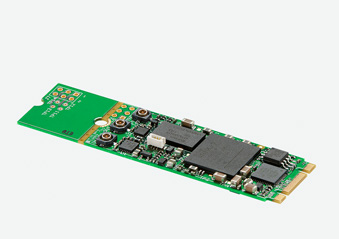
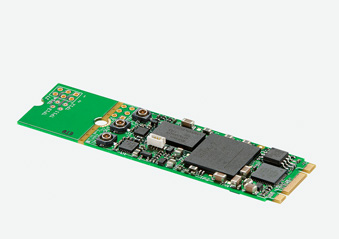
DeckLink SDI Micro is not a small USB capture dongle. It is a miniature M.2 card that uses one PCI Express Gen 3 lane and is specified for B- or M-key M.2 slots at 2260 or 2280 length. That makes it a specialist choice for a compact computer or a purpose-built carrier that actually exposes a compatible M.2 path. A free M.2 socket is not enough by itself: confirm its key, physical clearance, PCIe routing, operating-system driver support and whether installing the card conflicts with an SSD or another module. The manufacturer describes it as suitable for compact-computer solutions, but does not identify a particular carrier or certify every notebook slot. Its official [model entry](https://www.blackmagicdesign.com/products/decklink/models/) and [technical specification](https://www.blackmagicdesign.com/products/decklink/techspecs/W-DLK-30) are more useful than the name alone.
SDI, not HDMI, and a bounded HD ceiling
The documented signal family is 3G-SDI. Blackmagic lists SD and HD standards, including 720p and multiple 1080 formats through 1080p60. That is a sensible ceiling for a compact broadcast ingest or playback path when the source already speaks SDI; the “Micro” label does not imply UHD, 4K, HDMI input or an HDMI gaming-display loop. The specification says capture and playback can occur simultaneously and lists a Black Burst/Tri-Sync reference input, but it does not itemize a simple consumer-style connector count or promise that every combination of external equipment, cables and software is ready to go. Confirm the precise connector and breakout arrangement for the board and installation you are considering.
The sampling details matter when bit depth and chroma are part of the job. The page lists 4:2:2 and 4:4:4 sampling, with 8-, 10- and 12-bit RGB 4:4:4 through 1080p30; its YUV 4:2:2 specification lists 8- and 10-bit across the supported modes. Do not turn that into a claim of 12-bit RGB at 1080p60. Nor does a broad SD/HD timing list establish a rate-specific HDR recording mode: the product section supplies no HDR capture matrix.
Check the whole internal fit before choosing it
The official package list names the card and a fan-and-heatsink assembly. An SDI cable appears under available accessories, rather than the listed contents, so the exact retail package should be checked before assuming that a source cable or breakout is included. The added cooling hardware also deserves a clearance check in a thin or tightly packed chassis. A photo can help distinguish this M.2 board from a full-height PCIe DeckLink card, but it cannot show whether a computer has the right slot, signal wiring or airflow.
Blackmagic lists Windows 10 64-bit and Windows 11, Mac 15 Sequoia and Mac 26 Tahoe or later, and Linux. The model section does not spell out a named bundled application list or an OS-by-application support matrix. It is safer to verify the current Desktop Video driver, the exact M.2 host and the intended capture software together than to assume that an application choice is covered because another DeckLink model lists it. OBS, for example, is not named in this model section. This assessment therefore treats the 1080p60 SDI mode as a hardware-format statement, not a tested OBS preset or a promise about sustained recording on a particular computer.
How it differs from the nearby DeckLinks
For a normal workstation with an open PCIe slot, compare the SDI Micro with a standard DeckLink SDI card rather than treating M.2 as a universal convenience. The SDI 4K and Studio 4K families use conventional PCIe cards and publish different SDI, HDMI or analog paths; they are better candidates when you need those connectors or higher raster modes. At the other end, DeckLink Quad 2 targets a much larger multi-channel installation, with eight independently configurable 3G-SDI connections and an eight-lane PCIe host. The Micro's appeal is the small host footprint, not channel count or 4K performance.
Questions to settle before a purchase
First, confirm that the source output is SDI and check its exact raster, frame rate, scan type and signal level against the manufacturer table. Second, identify the M.2 slot's length, B/M keying and PCIe capability from the computer or carrier documentation. Third, confirm the physical SDI cable or adapter required, where the included fan and heatsink will sit, and which current driver and application version support the intended host. If a seller offers a bundle, compare its exact contents and condition rather than inferring them from the manufacturer's accessory list. These are specification-based checks; no hands-on installation, performance measurement, ownership or seller offer is claimed here.
Key specifications
Key details at a glance
| Signal input | 3G-SDI capture/playback connections; the exact section does not enumerate a connector count or provide a numbered I/O matrix / Black Burst/Tri-Sync reference input |
|---|---|
| Confirmed capture formats | SD: 525i59.94 NTSC, 625i50 PAL / HD: 720p50/59.94/60 / HD: 1080p23.98/24/25/29.97/30/50/59.94/60 / HD: 1080PsF23.98/24/25/29.97/30 and 1080i50/59.94/60 |
| Confirmed passthrough formats | |
| Computer connection | M.2 pci express gen 3 x1; compatible b- or m-key slot, length 2260 or 2280. verify the particular host/carrier, routing and clearance; this is not a standard full-size pcie add-in card. |
| Named compatible software | |
| HDR recording | No model-specific rate-by-rate hdr recording table is published. listed sampling and sdi compliance are not treated as a format-specific hdr capture guarantee. |
Use the exact model’s instructions for operating limits, supplied equipment and version differences.
Sources for this review
Sources for this assessment
Check your complete signal path
Choose the source format, desired captured signal, passthrough target, computer connection and software together. A single device must support that whole arrangement.