
Your needs, this model
Does it fit your priorities?
Will a standard HDMI cable plug directly into Corvid HB-R?
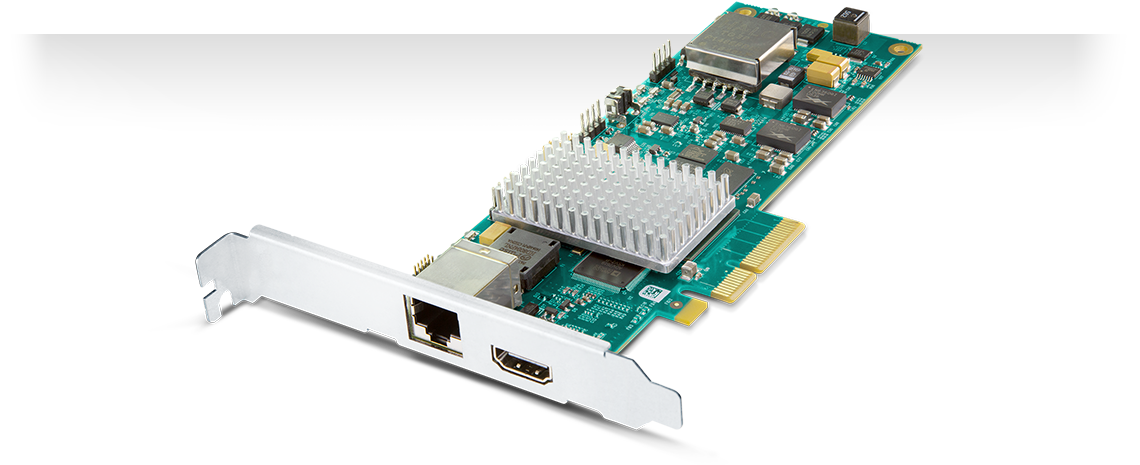
No. The board input is RJ-45 HDBaseT carrying an HDMI signal. It requires a compatible HDBaseT transmitter or camera endpoint; the RJ-45 connector is not Ethernet and is not a direct HDMI socket.
Explore this need in the finder →Can the board capture and loop 4K60?
AJA lists UHD/4K 50/59.94/60 at 8-bit 4:2:0 for the HDBaseT input and an active HDMI loop copy. Treat this as the same specialized HDBaseT source mode, not 4K60 HDR or HDMI 2.1 passthrough.
Explore this need in the finder →Is HDCP or EDID configuration available?
AJA explicitly says the board does not support HDCP-encrypted video and has no EDID interface. Check the camera/source’s negotiated output mode and use an unencrypted signal before planning a capture path.
Explore this need in the finder →Corvid HB-R is an earlier AJA OEM ingest board for HDMI video transported over HDBaseT. That distinction is central: its video input is a single RJ-45 HDBaseT connection, not a standard HDMI socket. It was developed for AJA RovoCam and similar HDBaseT camera systems, so it should not be treated as a direct HDMI console capture card. AJA marks the product discontinued and its SDK reference dates end-of-life to 2020.
HDBaseT in, an active HDMI copy out
AJA documents HDBaseT input carrying HDMI video, audio, control and power. Supported video formats extend through 4K/UHD 50, 59.94 and 60 at 8-bit 4:2:0; lower rates and HD/2K/SD formats are separately listed. The corresponding HDMI 1.4b output is an active loop of the signal negotiated at the receiver input. AJA says no EDID interface is provided and no HDCP-encrypted video is supported. That makes a 4K60 passthrough claim specifically a constrained HDBaseT camera/display path, not a universal HDMI 2.1 gaming chain or an HDR pass guarantee.
The card is also described as an OEM capture board, and the SDK reference lists capture formats recognized at its input. That supports a host capture path up to the documented 4K60 8-bit 4:2:0 modes; the card itself should not be confused with a recorder, encoder or completed stream. App integration and downstream recording are separate host-side work. This library does not pair the product with OBS or claim particular latency measurements. AJA’s 2016 announcement discussed V4L2 driver support for Linux, but a compatible software stack still needs to be checked.
The source, link and power must all fit
The input connector is RJ-45 carrying HDBaseT, not Ethernet networking. A compatible HDBaseT transmitter/camera and suitable cable are required between a conventional HDMI source and the card; the source must also avoid HDCP protection. The loop output mirrors the received signal, so display compatibility must be checked at the exact raster, frame rate, bit depth and chroma format. The lack of EDID control means the card cannot be treated as an ordinary monitor switcher where a user can freely force a display mode.
Corvid HB-R occupies a four-lane Gen 2 PCIe slot. It can provide up to 10 W over HDBaseT for a suitable endpoint, and the documents list two-channel embedded audio alongside camera microphone audio, plus bidirectional VISCA/RS-232 control and a USB host path intended for camera firmware updates. These are specialized installation features. They do not mean every HDBaseT camera, pinout or remote power arrangement is compatible; check the endpoint and power budget before buying. The chassis, PCIe slot, driver and camera system must be treated as one installation.
Who should look elsewhere
This is a useful fit only for a developer or integrator preserving an HDBaseT/RovoCam-style workflow that needs PCIe ingest and an HDMI loop copy. It is a poor match for anyone expecting to plug a console’s HDMI cable straight into the card, record protected content, use HDMI 2.1 passthrough, or install a USB peripheral on a laptop. Its higher-raster modes are not equivalent to HDR or 4:4:4 support.
Compared with the Corvid HEVC, HB-R is an HDBaseT camera-ingest and loop-output board; HEVC is a multi-input SDI encoder card. They serve different signal chains. Before considering a particular HB-R, verify the HDBaseT transmitter/camera, cable run, exact 8-bit 4:2:0 mode, non-HDCP source, display negotiation, Linux/application support and used-card condition. The manufacturer page does not establish current stock, warranty, included cabling or seller package contents.
Key specifications
Key details at a glance
| Signal input | 1 x RJ-45 HDBaseT input carrying HDMI 1.4b video/audio/control; 1 x active HDMI 1.4b loop output copying negotiated input; no EDID; no HDCP |
|---|---|
| Confirmed capture formats | HDBaseT-transported HDMI: UHD/4K through 2160p60 only at 8-bit 4:2:0 for 50/59.94/60; separate SD/HD/2K and lower-rate 4K modes |
| Confirmed passthrough formats | HDMI 1.4b active loop output mirrors the negotiated HDBaseT input; only 4K/UHD 50/59.94/60 is 8-bit 4:2:0 |
| Computer connection | 4-lane gen 2 pcie. |
| Named compatible software | AJA NTV2 SDK/developer integration |
| HDR recording | No rate-specific hdr recording mode is documented; do not infer hdr from input, an hdbaset loop or hevc capability. |
Use the exact model’s instructions for operating limits, supplied equipment and version differences.
Sources for this review
Sources for this assessment

Check your complete signal path
Choose the source format, desired captured signal, passthrough target, computer connection and software together. A single device must support that whole arrangement.